
Check legal thresholds, timelines and fees against the current law and the latest Commission guidelines before you teach.
Unit competency
Describe how the Commission is composed, appointed and led, and explain how its secretariat and field offices deliver its mandate.
Performance criteria
- The composition of the Commission and the qualifications of members are stated correctly.
- The appointment process is presented in the correct sequence.
- The distinct roles of the Commission (policy and oversight) and the Secretariat (implementation) are explained.
- Participants can direct a citizen to the correct IEBC office at constituency, county or national level.
Learning outcomes
| Knowledge | Skills | Attitudes |
|---|---|---|
| State the composition of the Commission and the qualifications of its members. Identify the current leadership of the Commission. Describe the structure of the Secretariat and field offices. | Illustrate the appointment process using a flow chart. Draw the organisational structure of the Commission. Direct citizens to the appropriate IEBC office. | Value merit, gender balance and integrity in the appointment of public officers. Respect the leadership of the Commission while remaining non-partisan. |
Key inquiry questions
- Who leads the IEBC, and how are they chosen?
- How does a decision made at the Commission headquarters reach a polling station in your ward?
Core competencies, values and PCIs
| Core competencies | Values | Pertinent and contemporary issues |
|---|---|---|
| Critical thinking; communication; learning to learn | Integrity; merit; accountability; equality | Gender equality in public appointments; public confidence |
Session 1: Composition, Qualifications and Appointment of Commissioners
Time: 45 minutes
Session outcomes
By the end of the session, the participant should be able to:
a) explain the composition of the Commission;
b) state the qualifications for appointment as Chairperson and member;
c) illustrate the process of appointing the Chairperson and members;
d) identify the current leadership of the Commission;
e) acknowledge the purpose of the appointment criteria.
Suggested learning experiences
Guide participants to:
- Draw a flow chart of the appointment process in groups and display it for a gallery walk and peer critique.
- Discuss why the Constitution requires the Chairperson and Vice-Chairperson to be of different genders.
- Identify the current Commissioners from official IEBC sources (website, Gazette notices) and present a short profile of the Commission's leadership.
Suggested resources
The Constitution of Kenya, 2010; IEBC Act, 2011 (as amended); Gazette Notices Nos. 9269 and 9270 of 10 July 2025; IEBC website; flip charts and marker pens.
Key notes
Composition
The IEBC consists of a Chairperson and six other members, appointed for a single, non-renewable term of six years. The members elect a Vice-Chairperson from among themselves. Under Article 250(11) of the Constitution, the Chairperson and the Vice-Chairperson must not be of the same gender.
Qualifications
- The Chairperson must be qualified to hold the office of a judge of the Supreme Court.
- A member must be a citizen of Kenya; hold a degree from a recognised university; have proven relevant experience in electoral matters, management, finance, governance, public administration or law; and meet the requirements of Chapter Six of the Constitution on leadership and integrity.
- A person who has, at any time within the preceding five years, held office or stood for election as a Member of Parliament or of a county assembly, or as a member of the governing body of a political party, or who holds any State office, is not eligible for appointment (Article 88(2)).
Appointment process
- A selection panel is constituted in accordance with the IEBC Act.
- The panel advertises the vacancies and invites applications from qualified persons.
- The panel shortlists and interviews applicants in public.
- The panel recommends two names for Chairperson and nine names for members to the President.
- The President nominates one person for Chairperson and six persons for members and submits the names to the National Assembly for approval.
- Upon approval, the President appoints the nominees by notice in the Gazette.
- The Chairperson and members take the oath of office before the Chief Justice.
- At its first plenary meeting, the Commission elects the Vice-Chairperson.
Current leadership of the Commission
The current Commission was sworn in before the Chief Justice on 11 July 2025, following its appointment by Gazette Notices Nos. 9269 and 9270 of 10 July 2025.
| Office | Name |
|---|---|
| Chairperson | Erastus Edung Ethekon, HSC |
| Vice-Chairperson | Fahima Araphat Abdallah |
| Commissioner | Ann Njeri Nderitu |
| Commissioner | Moses Alutalala Mukhwana |
| Commissioner | Mary Karen Sorobit |
| Commissioner | Hassan Noor Hassan |
| Commissioner | Francis Odhiambo Aduol |
| Commission Secretary/CEO (Ag.) | Ruth Kulundu (at the date of publication) |
Point to note
Leadership positions change. Before each training, confirm the current Commissioners and Commission Secretary from the IEBC website or the latest Gazette notice.
Session 2: The Commission, the Secretariat and Field Structures
Time: 45 minutes
Session outcomes
By the end of the session, the participant should be able to:
a) distinguish the roles of the Commission and the Secretariat;
b) describe the role of the Commission Secretary/Chief Executive Officer;
c) illustrate the organisational structure of the IEBC from headquarters to the polling station;
d) appreciate how teamwork across levels delivers credible elections.
Suggested learning experiences
Guide participants to:
- Draw the IEBC organogram from headquarters to the polling station and compare it with Figure 1.2.
- Role play a citizen seeking help to transfer registration, and identify the correct office and officer at each step.
- Discuss what could go wrong if the Commission and the Secretariat confused their roles.
Key notes
Roles of the Commission and the Secretariat
| The Commission (Chairperson and members) | The Secretariat (headed by the Commission Secretary/CEO) |
|---|---|
| Provides policy direction, strategy and oversight. | Implements the policies and decisions of the Commission. |
| Makes decisions in plenary and works through committees. | Manages day-to-day operations, staff and resources. |
| Approves regulations, plans, budgets and the election calendar. | Plans and delivers registration, voter education, logistics, ICT and election operations. |
| Hears specified disputes through its committees. | Provides technical and legal support to Commission committees. |
| Is the face of the Commission; the Chairperson is the national returning officer for the presidential election. | The Commission Secretary is the accounting officer and secretary to the Commission. |
The Commission Secretary/CEO is competitively recruited by the Commission. The Secretariat is organised into directorates responsible for functions such as voter registration and electoral operations; voter education and partnerships; information and communication technology; legal and public compliance; communication and corporate affairs; finance; human resource and administration; supply chain management; and research, planning and strategy.
Commission committees
The Commission performs some functions through committees, including two that have statutory roles relevant to voter education:
- the Electoral Code of Conduct Enforcement Committee, which enforces the Electoral Code of Conduct; and
- the Dispute Resolution Committee, which hears disputes arising from nominations and candidate registration.
Field structures
The Commission's work reaches citizens through a field structure that mirrors the country's electoral units:
| Level | Office | Key responsibilities |
|---|---|---|
| National | Headquarters, Nairobi | Policy, planning, national tallying of presidential results, national voter education campaigns |
| Regional | Regional Election Coordinators | Coordination and supervision of counties in a region |
| County (47) | County Election Managers; County Returning Officers during elections | County planning, stakeholder coordination, county tallying |
| Constituency (290) | Constituency Election Coordinators; Constituency Returning Officers during elections | Voter registration, voter education, recruitment of election officials, constituency tallying |
| Ward and polling station | Registration officers, voter educators, Presiding Officers, Deputy Presiding Officers and clerks | Direct services to voters |
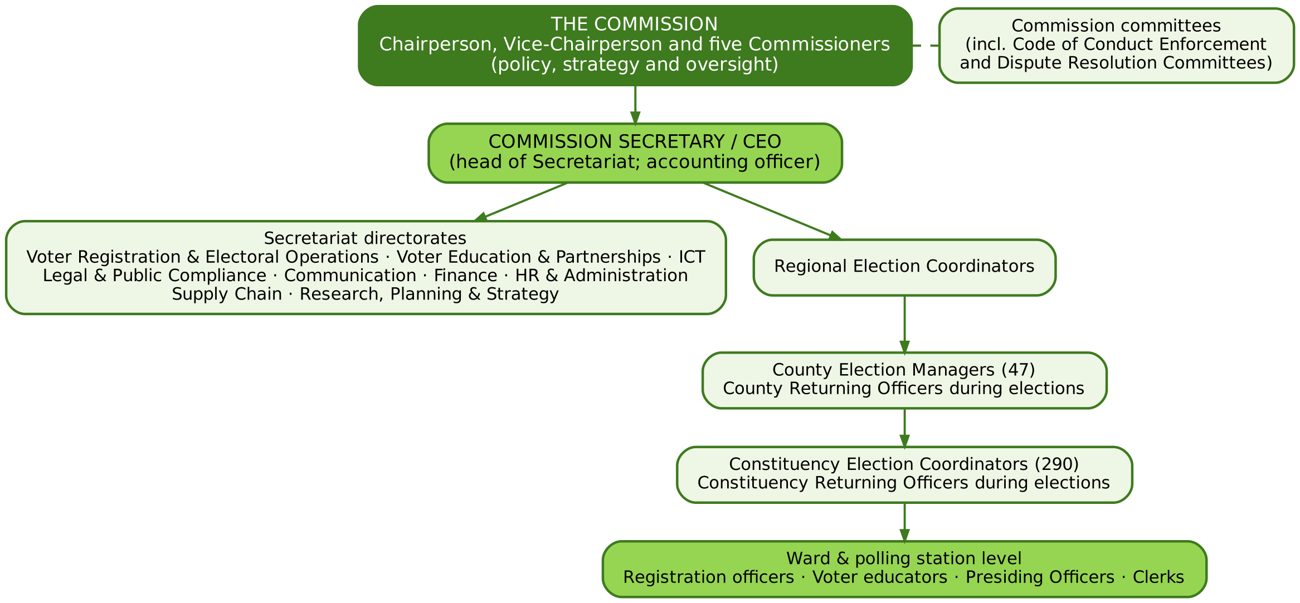
Figure 1.2: Simplified organisational structure of the IEBC
Assessment
| Criterion | 4 – Exceeds | 3 – Meets | 2 – Approaches | 1 – Below |
|---|---|---|---|---|
| Composition and qualifications | States all accurately and explains their purpose | States composition and qualifications correctly | States some correctly | Cannot state them |
| Appointment process | Correct sequence with reasons for each safeguard | Correct sequence | Sequence partly correct | Incorrect sequence |
| Structure and referral | Accurately maps structure and refers citizens in all scenarios | Distinguishes Commission and Secretariat; refers citizens correctly | Partial understanding of the structure | Cannot describe the structure |
Evidence of competence: an accurate appointment flow chart and organogram, and observed performance in the referral role play.