
Check legal thresholds, timelines and fees against the current law and the latest Commission guidelines before you teach.
Unit competency
Explain what the Commission, citizens and other stakeholders do in each phase of the electoral cycle, and guide citizens to participate at the right time.
Performance criteria
- The three phases of the electoral cycle are described with their key activities.
- The responsible office within the Commission is identified for each major activity.
- The citizen's role in each phase is explained.
- An accurate electoral cycle diagram is produced.
Learning outcomes
| Knowledge | Skills | Attitudes |
|---|---|---|
| Describe activities in the pre-election, election and post-election periods. Identify who in the Commission leads each activity. | Illustrate the electoral cycle. Advise citizens on when and how to participate. | Appreciate that elections are a continuous process, not a single-day event. Uphold integrity in all electoral activities. |
Key inquiry questions
- Why is an election described as a cycle rather than an event?
- What should a citizen be doing today, wherever we are in the cycle?
Session 1: Phases and Activities of the Electoral Cycle
Time: 45 minutes
Suggested learning experiences
Guide participants to:
- Brainstorm activities they associate with elections and arrange them on a circular wall chart.
- Compare their chart with Figure 1.4 and identify any missing activities.
- Simulate selected activities from each phase.
Suggested resources
IEBC Strategic Plan 2024–2029; IEBC Election Operations Plan; Electoral Code of Conduct; electoral cycle chart; flip charts.
Key notes
The electoral cycle is the continuous sequence of activities through which elections are planned, conducted, evaluated and improved. Each phase builds on the lessons of the previous one.
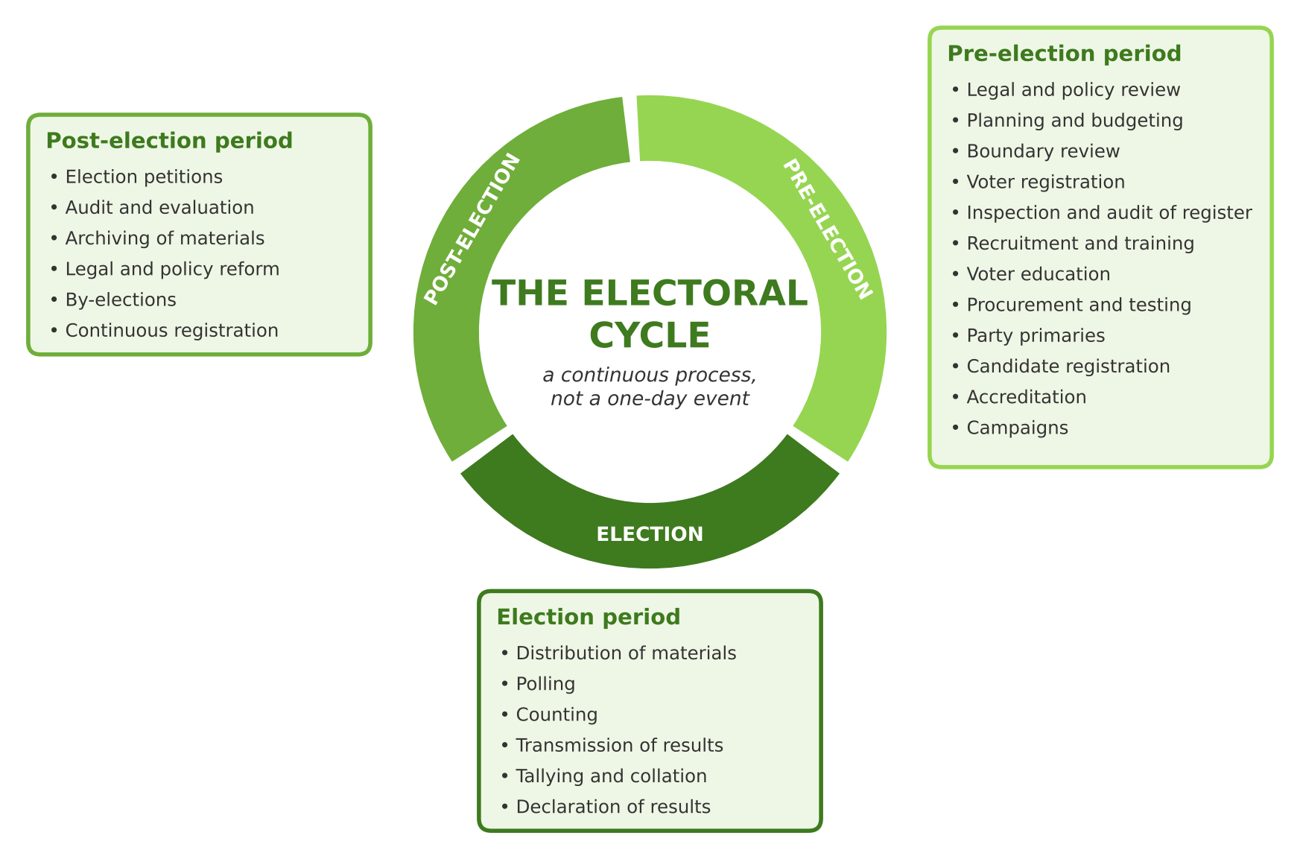
Figure 1.4: The electoral cycle
Pre-election period
- Legal and policy review and preparation of regulations
- Strategic and operational planning, budgeting and funding
- Review of boundaries (at constitutionally prescribed intervals)
- Continuous and mass voter registration; inspection and audit of the Register of Voters
- Recruitment and training of election officials
- Voter education and stakeholder engagement
- Procurement and acceptance testing of election materials and technology
- Party primaries (regulated by the Commission) and registration of candidates
- Accreditation of observers, agents and media
- Election campaigns and enforcement of the Electoral Code of Conduct
Election period
- Distribution of election materials and setting up of polling stations
- Polling
- Counting of votes at the polling station
- Transmission, tallying and collation of results
- Announcement and declaration of results
Post-election period
- Hearing and determination of election petitions by the courts
- Post-election audit and evaluation
- Archiving of election materials and records
- Legal, policy and institutional reforms
- By-elections and recall elections where vacancies arise
- Resumption of continuous voter registration and civic engagement
Session 2: Who Does What Across the Cycle
Time: 45 minutes
Suggested learning experiences
Guide participants to:
- Complete the table below in groups by adding the citizen's role in each phase.
- Develop a one-page "what to do now" guide for citizens for the current phase of the cycle.
Key notes
| Phase | Key Commission activities | Lead within the Commission | Role of the citizen |
|---|---|---|---|
| Pre-election | Voter registration, inspection of the register, voter education, candidate registration, regulation of nominations, Code of Conduct enforcement | Commission (policy and approvals); Secretariat directorates; County and Constituency Election Coordinators; Code of Conduct Enforcement and Dispute Resolution Committees | Register; verify registration details; join a party voluntarily; scrutinise aspirants; report offences |
| Election | Polling, counting, transmission, tallying and declaration of results | Chairperson (presidential results); County and Constituency Returning Officers; Presiding Officers | Vote peacefully; observe the Code of Conduct; follow official results |
| Post-election | Evaluation, audit, archiving, by-elections, reforms | Commission; Secretariat; courts (for petitions) | Accept lawful outcomes or use the courts; hold leaders accountable; take part in reform consultations |
Assessment
| Criterion | 4 – Exceeds | 3 – Meets | 2 – Approaches | 1 – Below |
|---|---|---|---|---|
| Electoral cycle | Complete, accurate diagram with links between phases | Accurate diagram showing all three phases | Diagram missing key activities | Cannot illustrate the cycle |
| Roles across the cycle | Accurately assigns all roles and explains how they interact | Correctly identifies Commission and citizen roles in each phase | Identifies some roles | Confuses roles |
Evidence of competence: an electoral cycle chart and a one-page citizen guide for the current phase.