
Check legal thresholds, timelines and fees against the current law and the latest Commission guidelines before you teach.
Unit competency
Explain the rules that govern election campaigns and promote issue-based, peaceful and lawful campaigning.
Performance criteria
- The campaign period and the persons entitled to campaign are stated correctly.
- The provisions of the Electoral Code of Conduct are explained with examples.
- The roles of election officials and security agencies during campaigns are described.
- A harmonised campaign schedule is prepared correctly.
Learning outcomes
| Knowledge | Skills | Attitudes |
|---|---|---|
| Explain the meaning and importance of campaigns. State the campaign period and campaign regulations. Describe the provisions of the Electoral Code of Conduct. | Prepare a harmonised campaign schedule. Identify breaches of the Code of Conduct in scenarios. | Value issue-based and peaceful campaigns. Reject hate speech and violence. |
Session 1: Election Campaigns and the Electoral Code of Conduct
Time: 1 hour
Suggested learning experiences
Guide participants to:
- Discuss the importance of the election campaign period.
- Brainstorm the provisions of the Electoral Code of Conduct.
- Draw a sample one-week campaign schedule for three candidates in one ward and harmonise it to avoid clashes.
- Discuss the roles of security agencies and election officials during campaigns.
Suggested resources
Elections Act, 2011; Electoral Code of Conduct (Second Schedule to the Elections Act); Elections (General) Regulations, 2012; sample campaign schedules.
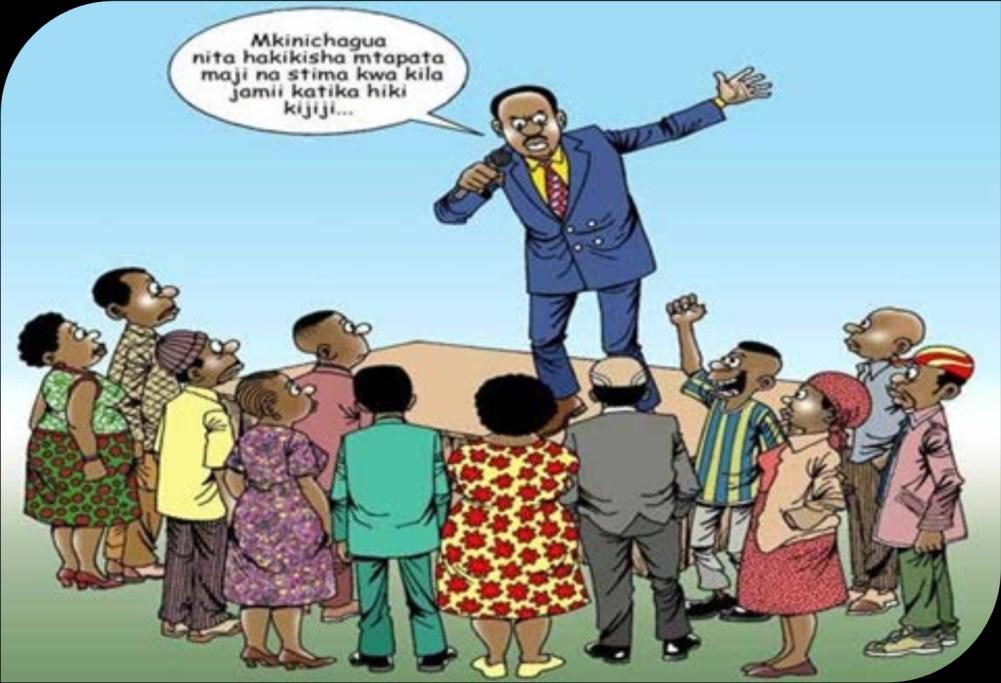
Figure 3.9: Candidates campaigning
Key notes
Meaning of an election campaign
An election campaign is the process through which political parties and candidates, after being registered by the Commission, seek the support of voters. Campaign activities include public meetings and rallies, door-to-door canvassing, road shows, distribution of campaign materials, and the use of broadcast, print and social media.
Campaign period
The campaign period is set by the Commission for each election. It begins after the registration of candidates and ends forty-eight hours before election day. The Commission harmonises campaign schedules before the campaign period to avoid clashes of venues and dates.
Persons entitled to campaign
- Candidates.
- Political parties and their appointed campaigners.
- Supporters of candidates.
Point to note
Public officers are prohibited by the Elections Act and the Political Parties Act from campaigning for, or publicly supporting, a candidate or political party. Public resources may not be used for campaigns.
Campaign regulations
- Only registered political parties and candidates registered by the Commission may campaign.
- Candidates must operate a designated campaign bank account and comply with campaign-financing law.
- Candidates and parties must submit campaign schedules and notify the police of public meetings in advance.
- Campaigners must respect the property and campaign materials of other candidates.
- Campaigners must use appropriate language and avoid hate speech, incitement and false statements.
- No campaigns may take place in places of worship (unless permitted by law), at polling stations, or during the forty-eight hours before polling.
Importance of election campaigns
- They inform voters about candidates, parties and manifestos.
- They enable voters to assess candidates' leadership qualities.
- They increase public understanding of political, social and economic issues.
- They encourage voter turnout.
- They support voter education.
Electoral Code of Conduct
All political parties and candidates must sign and comply with the Electoral Code of Conduct. Under the Code, they must:
- publicly and repeatedly condemn violence and intimidation;
- avoid abusive, intimidating or provocative language;
- ensure that no weapons are carried or displayed at any political function;
- refrain from publishing false information;
- avoid defamatory or inflammatory allegations against any person or party;
- cooperate with other parties to avoid clashing campaign programmes;
- cooperate with stakeholders in voter education;
- avoid copying other parties' or candidates' symbols, colours or acronyms;
- prevent the removal, defacing or destruction of other parties' campaign materials;
- avoid undue influence on voters, including through family, lineage or office;
- refrain from abusing positions of power, privilege and influence; and
- avoid discrimination on the basis of age, race, ethnicity, class, gender, disability or religion.
Roles during campaigns
| Actor | Role |
|---|---|
| IEBC election officials | Harmonise schedules; monitor compliance with the Code of Conduct; receive complaints; refer breaches to the Code of Conduct Enforcement Committee. |
| Security agencies | Provide security at campaign events; protect candidates and voters; prevent and respond to violence; investigate offences. |
Assessment
| Criterion | 4 – Exceeds | 3 – Meets | 2 – Approaches | 1 – Below |
|---|---|---|---|---|
| Campaign rules | Explains rules and their purpose, citing the law | States the campaign period, entitlements and rules correctly | Partly correct | Incorrect |
| Code of Conduct | Identifies all breaches in scenarios and the correct remedy | Identifies breaches correctly | Identifies some breaches | Cannot identify |
| Harmonised schedule | Clash-free, realistic schedule with security notifications | Clash-free schedule | Schedule with clashes | No schedule |
Evidence of competence: a harmonised campaign schedule and a scenario worksheet.