
Check legal thresholds, timelines and fees against the current law and the latest Commission guidelines before you teach.
Unit competency
Demonstrate the voting procedure at a polling station, including the correct marking of ballot papers and the assistance of voters, and explain the roles and rules that protect the secrecy and integrity of the vote.
Performance criteria
- Polling day, polling hours and pre-polling activities are stated correctly.
- Persons allowed in the polling station and their identification documents are identified correctly.
- A ballot paper is marked correctly and cast in the correct box.
- The voting procedure, including assisted voting, is demonstrated step by step.
- The provisions of the Electoral Code of Conduct during polling are explained.
Learning outcomes
| Knowledge | Skills | Attitudes |
|---|---|---|
| Explain the meaning of polling. Identify persons allowed in the polling station. Describe the features of a ballot paper and a correctly marked ballot. Describe the roles of election officials during polling. | Mark a ballot paper correctly. Demonstrate the voting procedure. Demonstrate the procedure for assisting a voter. | Appreciate the importance of the secrecy of the ballot. Show respect and priority for voters with special needs. |
Key inquiry question
- What must happen at a polling station for every voter to cast a free and secret vote?
Session 1: Meaning of Polling and Activities Before Polling
Time: 30 minutes
Suggested learning experiences
Guide participants to:
- Brainstorm the meaning of polling and share.
- Draw a chart showing the documents required to vote.
Suggested resources
The Constitution of Kenya, 2010; Elections (General) Regulations, 2012; video clips of polling activities; sample ballot papers and ballot boxes; polling station layout charts; directional arrows and posters.
Key notes
Polling is the casting of votes in an election on a date and at times set by law, during which voters choose their preferred leaders.
- A general election is held on the second Tuesday of August in every fifth year.
- By-elections, referendums and recall elections are held on dates set by the Commission in accordance with the law.
- Polling stations open at 6.00 a.m. and close at 5.00 p.m. Voters who are in the queue at 5.00 p.m. are allowed to vote.
Activities before polling
- Voters confirm their polling stations through SMS, the online portal or the register displayed at the polling station.
- The polling station register is displayed at the polling station before election day.
- Voters receive information on voting requirements and procedures.
- Election officials inspect the polling station, receive and confirm materials, set up and demarcate the station, assign duties and brief agents and observers.
Session 2: Persons Allowed in the Polling Station and Use of Technology
Time: 30 minutes
Suggested learning experiences
Guide participants to:
- Debate who should and should not be allowed in the polling station.
- Discuss the use of technology in the identification of voters.
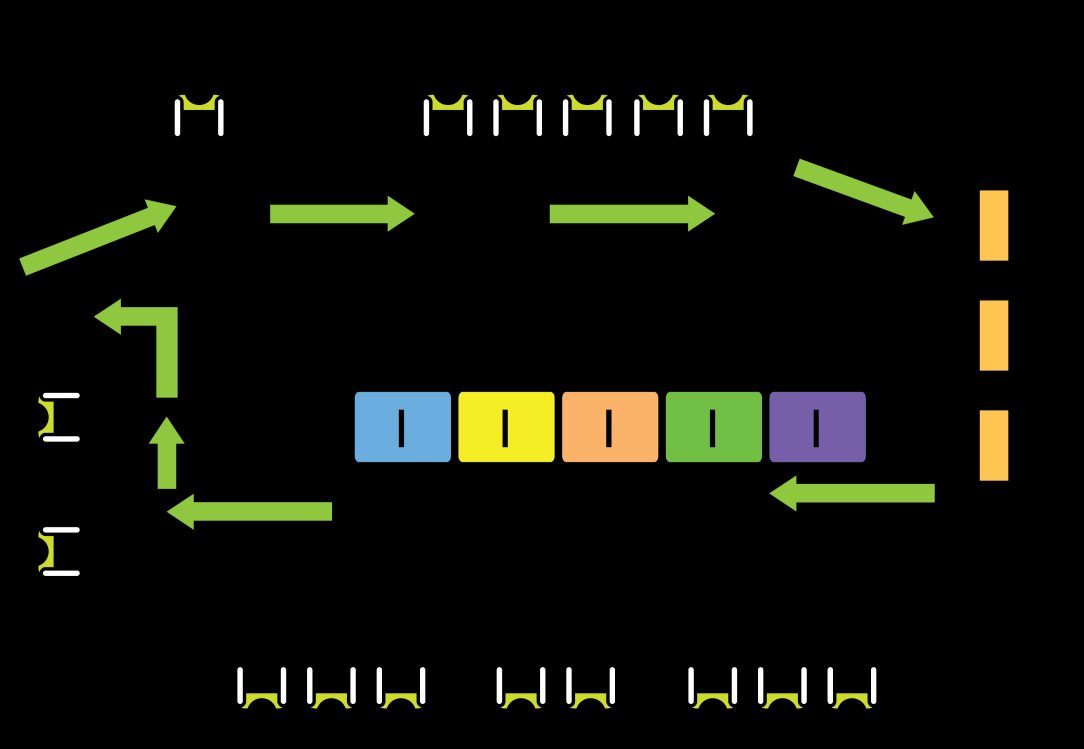
Figure 3.11a: Polling station layout
Key notes
| Person allowed in the polling station | Identification required |
|---|---|
| IEBC election officials | Official badge showing the designation |
| Voters | The national identity card or valid Kenyan passport used at registration |
| Candidates | National identity card and candidate's credentials |
| Accredited agents | National identity card, letter of appointment and oath of secrecy |
| Accredited observers | Accreditation badge |
| Accredited media | Accreditation card |
| Persons assisting voters | National identity card and oath of secrecy |
| Security officers on duty | Official uniform and identification |
Technology during polling
- The use of technology in voter identification is provided for in the Elections Act and the Elections (Technology) Regulations.
- The Kenya Integrated Elections Management System (KIEMS) identifies voters biometrically, which reduces impersonation.
- Technology helps direct voters to their correct polling stations.
- The law provides a complementary mechanism for identifying a voter where biometric identification fails, in accordance with the regulations.
Session 3: Features and Marking of Ballot Papers
Time: 45 minutes
Suggested learning experiences
Guide participants to:
- Draw a diagram showing the colours of ballot papers and ballot box lids for the six elective positions.
- Simulate marking a ballot paper and casting it in the correct ballot box.
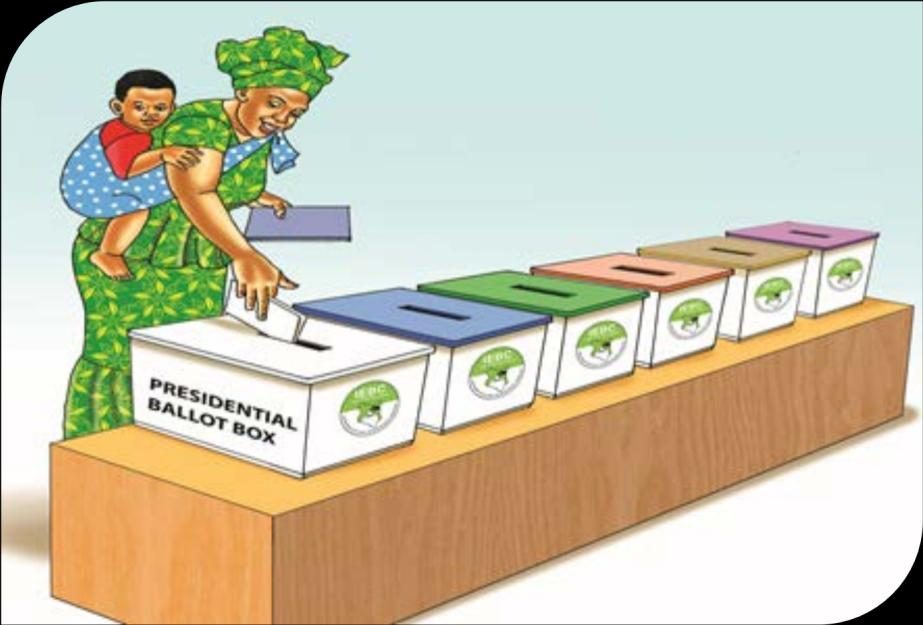
Figure 3.11b: A voter casts a presidential ballot paper in the presidential ballot box
Key notes
A ballot paper is an official document that bears the names, photographs and, where applicable, party symbols of the candidates for an elective position.
Features of a ballot paper
- Serial number and counterfoil.
- Names and photographs of candidates.
- Party symbols, or the symbols of independent candidates.
- Marking spaces.
- Instructions to the voter.
- Security features.
- A colour that corresponds to the lid of the ballot box for that elective position.
Colour coding used in the 2022 General Election
| Elective position | Ballot paper and ballot box lid colour |
|---|---|
| President | White |
| Member of the National Assembly | Green |
| Member of the County Assembly | Beige |
| Senator | Yellow |
| County Woman Member of the National Assembly | Purple |
| County Governor | Blue |
Point to note
The Commission confirms the colour coding for each election. Use the official specimen ballot papers issued for the election concerned.
Marking a ballot paper correctly
- Mark in the space next to the name, photograph and symbol of the candidate of your choice.
- Make only one mark on each ballot paper, within the space provided.
- Do not write your name or any mark that could identify you.
- Fold the ballot paper and cast it in the ballot box whose lid colour matches the ballot paper.
A correctly marked ballot paper bears the official stamp of the Commission at the back, has a mark against only one candidate, and has the mark within the space provided.
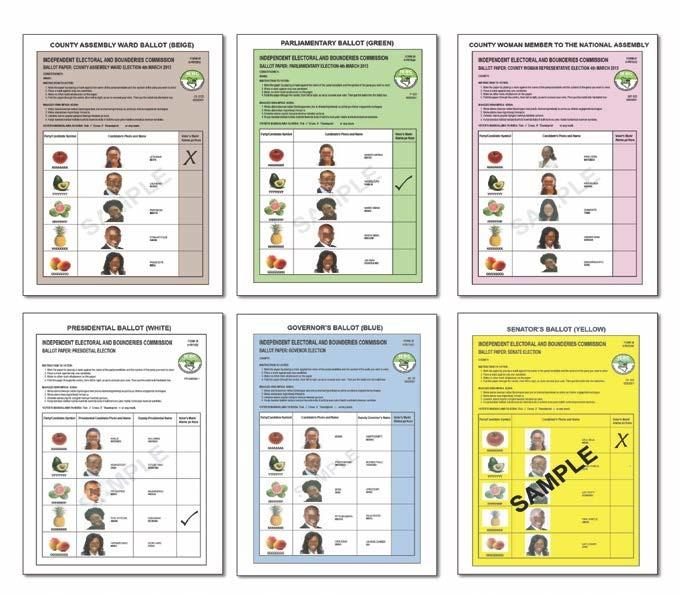
Figure 3.11c: Samples of ballot papers
Session 4: Voting Procedure, Roles of Officials and Conduct During Polling
Time: 45 minutes
Suggested learning experiences
Guide participants to:
- Role play the full voting procedure, rotating the roles of voter, clerk, Presiding Officer, agent and observer.
- Demonstrate the procedure for assisting a voter, including a voter who is blind and a voter who cannot read.
- Watch a video of polling and discuss the conduct demonstrated.
Key notes
Voting procedure
- Queuing: Voters queue in an orderly manner and enter the polling station one at a time. Older persons, persons with disabilities, the sick, pregnant women and mothers with infants are given priority.
- Identification: A clerk checks that the voter has not already been marked with indelible ink, requests the identification document, and identifies the voter electronically. A voter without the identification document used at registration cannot vote.
- Verification: The clerk confirms the voter's details in the register and calls out the voter's name. If the name is missing or the details are incorrect, the voter is referred to the Presiding Officer.
- Issue of ballot papers: Each ballot paper is stamped at the back, detached from the counterfoil and issued to the voter.
- Marking and casting: The voter marks each ballot paper secretly in the booth, folds it and casts it in the ballot box whose lid colour matches the paper.
- Inking: The voter's left little finger is marked with indelible ink (where nail polish or henna prevents this, the alternative place prescribed by the Commission is used).
- Exit: The voter leaves the polling station immediately.
Assisting a voter who cannot vote unaided
- A voter who requires assistance may bring a person of their choice, who must be at least 18 years old, must take an oath of secrecy, and may assist only one voter.
- If the voter has no assistant, the Presiding Officer assists, in the presence of agents, and marks the ballot paper as directed by the voter.
- The assistant is marked with indelible ink as prescribed by the Commission.
- Tactile ballot guides and other aids are provided for voters with visual impairments where available.
Roles of election officials during polling
| Official | Key roles |
|---|---|
| Returning Officer | The Commission's representative in the electoral area; recruits, trains and supervises officials; receives results from polling stations; resolves disputed votes; tallies and declares results; issues certificates to winners. |
| Deputy Returning Officer | Assists the Returning Officer and acts in their absence. |
| Presiding Officer | In charge of the polling station; controls admission; briefs agents; supervises clerks; assists voters who require help; administers the oath of secrecy to assistants; secures materials; updates the Returning Officer on turnout and incidents; counts votes, announces results and transmits them. |
| Deputy Presiding Officer | Assists and deputises for the Presiding Officer; ensures the safe retrieval of materials. |
| Polling clerks | Set up the station; manage queues; identify voters electronically; verify details; issue ballot papers; ink voters; secure materials in their custody. |
| Security officers | Maintain law and order; protect officials, voters and materials; escort materials. They act on the instructions of the Presiding Officer within the polling station. |
Electoral Code of Conduct during polling
- No one may bribe voters or canvass for votes at or near the polling station.
- No campaign materials may be displayed or distributed at or near the polling station.
- Voters may not wear clothing bearing a candidate's or party's slogan, symbol or photograph.
- Voters may not chant slogans, sing or dance at the polling station.
- Voters should leave the polling station after voting.
- The secrecy of the vote must be maintained.
- No one may engage in violence, intimidation or threats.
- Election officials must not leave the polling station before the conclusion of polling, counting and transmission of results.
Assessment
| Criterion | 4 – Exceeds | 3 – Meets | 2 – Approaches | 1 – Below |
|---|---|---|---|---|
| Ballot marking | Marks correctly and explains every validity rule | Marks correctly and casts in the correct box | Minor error | Invalid mark |
| Voting procedure | Demonstrates all steps fluently, including incidents | Demonstrates all steps correctly | Omits steps | Cannot demonstrate |
| Assisted voting | Demonstrates with dignity and full secrecy safeguards | Demonstrates correctly | Omits a safeguard | Incorrect |
Evidence of competence: observed polling simulation and assisted-voting demonstration.