
Check legal thresholds, timelines and fees against the current law and the latest Commission guidelines before you teach.
Unit competency
Explain the purpose, types, accreditation and code of conduct of election observation, and the rights and limits of observers.
Learning outcomes
| Knowledge | Skills | Attitudes |
|---|---|---|
| Explain the meaning and importance of election observation. Identify the types of observers. Describe accreditation and the code of conduct. | Role play an observer at a polling station. | Appreciate observation as a tool for transparency and improvement. |
Session 1: Meaning, Importance and Types of Election Observation
Time: 30 minutes
Suggested learning experiences
Guide participants to:
- Brainstorm the meaning of election observation.
- Discuss the importance of election observation.
- Identify the types of observers and observer groups.
Suggested resources
Elections Act, 2011; IEBC Guidelines for Election Observers; Declaration of Principles for International Election Observation; sample accreditation badge.
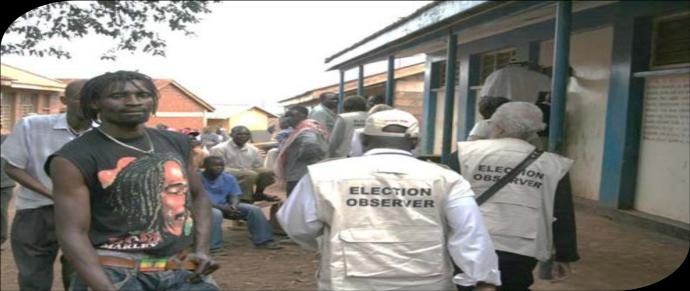
Figure 3.16: Election observers
Key notes
An election observer is a person accredited by the Commission to gather information on the electoral process and make an independent assessment of it, without interfering in the process. The Commission accredits observer groups, which may be domestic or international, and long-term or short-term.
Importance of election observation
- It detects and deters malpractice.
- It provides information for improving the electoral system.
- It highlights issues unique to particular areas.
- It influences future electoral policy.
- It identifies violations of voters' and human rights.
- It increases public confidence in the electoral process.
Types of observers
| Type | Description |
|---|---|
| Long-term observers | Observe the whole electoral cycle, including registration, nominations and campaigns. |
| Short-term observers | Observe activities around election day, such as polling, counting and tallying. |
| Domestic observers | Kenyan organisations and citizens. |
| International observers | Foreign governments, regional and international organisations and foreign NGOs. |
Session 2: Accreditation, Roles and Code of Conduct of Observers
Time: 30 minutes
Suggested learning experiences
Guide participants to:
- Role play observers at a polling station, including how to handle a request from a voter for help.
- Discuss the code of conduct for election observers.
Key notes
Bodies that may apply for accreditation
- Regional, continental and international inter-governmental organisations.
- Representatives of foreign missions.
- Domestic and international non-governmental organisations.
- Kenyan institutions and organisations.
- Any other body the Commission considers qualified.
Accreditation requirements
Domestic observer groups apply in writing, using the Commission's forms signed by authorised officials, and attach: their registration certificate; the names of their national officials; their constitution; evidence of their capacity, including a budget and deployment plan; a commitment to impartiality and non-partisanship; and a commitment to comply with the lawful instructions of the Commission. They provide the names and identification of observers and two contact persons.
International observer groups submit an application listing proposed observers and their passport or identity numbers, an authorisation for two contact persons, a signed declaration by each observer, and a mission statement of not more than two pages. Their assistants must also be accredited.
Responsibilities of observers
- Meet the costs of their mission, including travel and immigration requirements.
- Introduce themselves to the Presiding or Returning Officer on arrival.
- Carry and present their accreditation documents when requested.
- Comply with the lawful instructions of election officials, recording any dissatisfaction in their reports.
- Remain impartial and avoid confrontation with officials, security personnel and agents.
- Not handle election materials or assist in voting or counting.
- Not intervene in disputes, but record complaints made to them.
- Have a deployment plan for the stations to be covered.
Code of conduct for election observers
Observers must be impartial and report accurately; remain neutral; act honestly; behave properly; respect local cultures; and respect election officials and voters.
Assessment
| Criterion | 4 – Exceeds | 3 – Meets | 2 – Approaches | 1 – Below |
|---|---|---|---|---|
| Observation | Explains all aspects and models exemplary observer conduct | Explains types, accreditation and conduct correctly | Partly correct | Incorrect |
Evidence of competence: an observed observer role play.